
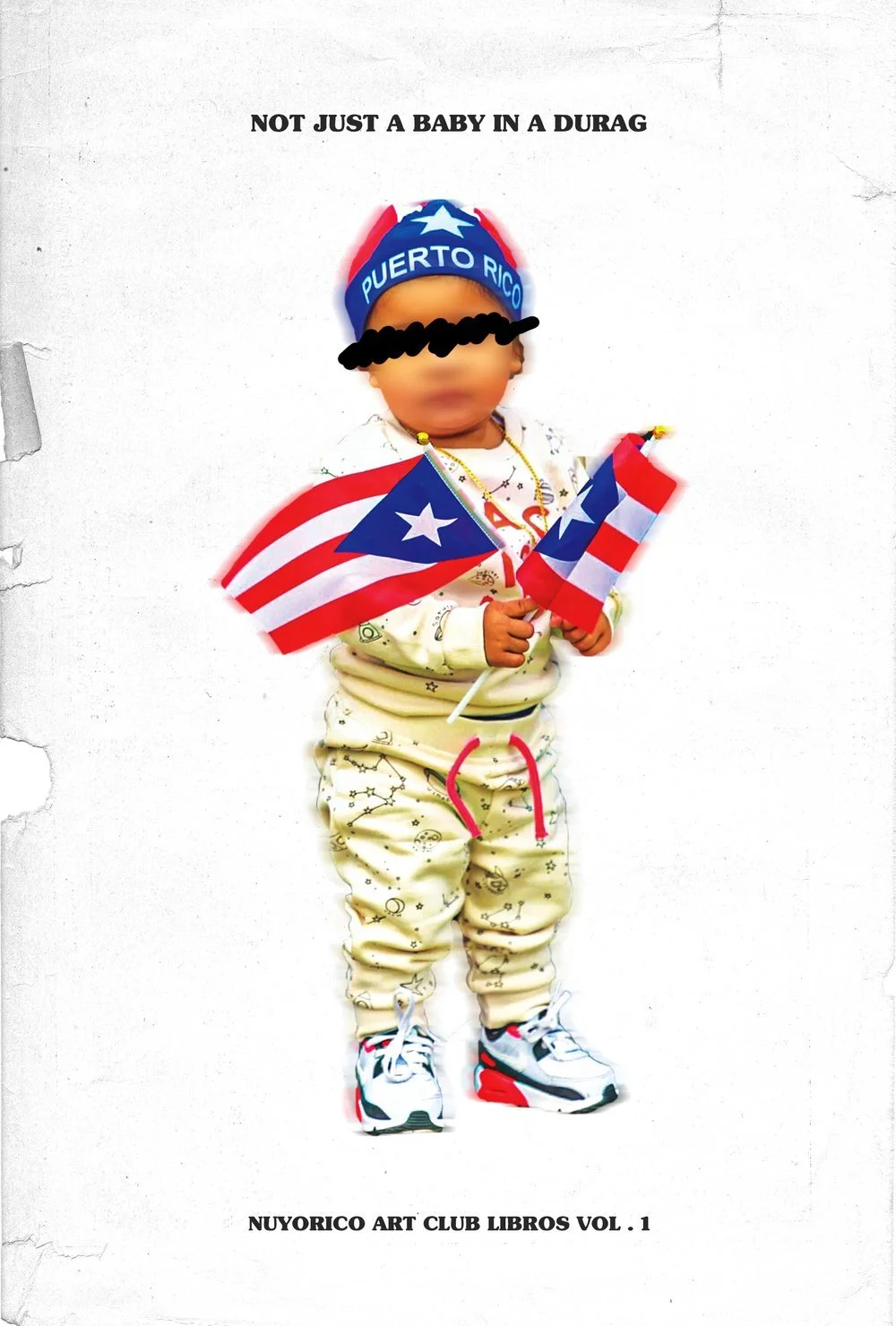
Deities, Doorknockers, and Dreams: Christian Mártir and Adrían Román on ‘not just a baby in a durag’
Nuyorico Art Club founders Christian Mártir and Adrián Román talk identity, Diasporicanness, and cultura in Not Just A Baby In A Durag.

not just a baby in a durag | nuyorico art club libros, vol 1.
READ IN SPANISH | LEE EN ESPAÑOL
One sunny Saturday afternoon during June 2023’s Puerto Rican Weekend, a compelling collection of Nuyorican art was on full display at CCLCTV Gallery in Loisaida (or, the Lower East Side). The diverse body of work featured in NUYORICO PRESENTE!, the exhibition curated by NUYORICO ART CLUB on the eve of the 66th Annual National Puerto Rican Day Parade, came together to explore the many experiences woven into Nuyorican identity. Showcasing works by established and emerging artists alike, NUYORICO PRESENTE! celebrated Puerto Rican/Nuyorican heritage across time, space, and mediums as a means to encourage meaningful dialogue between generations and allow for deeper explorations of Puerto Rican artistic traditions.
Founded by interdisciplinary artist and advocate Adrián ‘Viajero’ Román and graphic artist and cultural consultant Christian Mártir, NUYORICO ART CLUB was founded “on the belief that art has the power to transcend boundaries, challenge perceptions, and ignite transformative cultural change.” During NUYORICO PRESENTE!, Román and Mártir, with the help of art dealer and independent curator Natashia Betancourt, released not just a baby in a durag | NUYORICO ART CLUB LIBROS, VOL. 1, a collection of original digital collages comprised of layered images, symbols, and text, whose visual language speaks to the complexities of what it means to be Puerto Rican-Nuyorican-Boricua aquí, y allá. As this year’s Puerto Rican Heritage Month comes to a close, we speak to Román and Mártir about NUYORICO ART CLUB, the creative processes behind not just a baby in a durag, and art as a tool for navigating identity and combatting colonialismo.

‘HARLEM ON MY MIND.’ not just a baby in a durag | nuyorico art club libros, vol 1.
What was the impetus for NUYORICO ART CLUB?
Christian Mártir: The impetus was need. It grew out of conversations that were being had by some of us about the need to support one another in authentic ways and also to do work that inspires our community. Not simply romanticizing our past, but working today to continue the legacy that was left us.
Adrián Román: [and to] preserve our Nuyorican identity and existence as art and cultural influencers in New York. We’re dedicated to providing space as a community to amplify the voices that represent our cultural heritage, and to always create an environment that fosters mutual support and collaboration.
As artists, cultural makers, and fathers, why is it important that your lives, personal and professional, center Nuyorican identity? What does it mean to be Nuyorican?
CM: Centering my identity is crucial because it’s the key to our survival. As colonized people, we are constantly at the threat of what is ours being taken. Culture serves as one of if not the most powerful tools that we can utilize to defeat colonialism. Colonialism’s strength lies in destroying the unique characteristics and nature of the people it wishes to control. The colonizer knows and understands that to be successful, he must break the individual and their culture, to implement in its place the culture and attitudes of the colonizer. This allows the notions of superiority of the colonizer to be cemented into the colonized. He, the colonizer, realizes that if the colonized maintain their culture and value system, they will never be fully entrenched in the oppressive and inhumane conditioning of colonialism. So long as people are conscious of their uniqueness and identify themselves with it, they will fight to liberate themselves.
In the same way that the colonizer understands their mechanism’s importance, so should we who are conscious of their attempts to utilize it, to utilize our weapon of cultural reaffirmation. When we become conscious of who we are, we break the limitations and cleanse ourselves of the conditioning of colonialism. By seeking knowledge of self, we seek to be liberated. We enable ourselves to see and strive to go beyond the limited and weak position that colonialism places us in.
As a father, I feel a great responsibility to teach my daughter who she is before they tell her lies about who she is. The term Nuyorican is a special one. I once read how the initial idea came from the word Neo-Rican, meaning new Puerto Rican. This idea spoke to the spiritual and cultural awakening that was taking place in New York City amongst Puerto Ricans in the late 1960s and ‘70s. The thinking was that from this awakening, a new Puerto Rican was being born. It in time took a simpler definition of a Puerto Rican living in New York. I think even more specifically, a Puerto Rican born or raised in New York.
AR: My Nuyorican identity serves as the cornerstone for my creativity, cultural impact, and my role as a father. I embrace and pay homage to our deep-rooted legacy that spans from the archipelago of Puerto Rico to the streets of New York … and beyond. We believe in the importance of advocating for Puerto Rico’s fundamental right for self-determination. It’s imperative that we contribute to a legacy of resilience, strength, and cultural pride, inspiring future generations to continue the fight for justice and liberation. The inspiration behind Caras Lindas, my children's book series and toys featuring Puerto Rican historical icons, leaders, and visionaries, stems from my desire to instill a strong cultural foundation in my daughters. I aim to equip them with the knowledge to educate others who may lack a similar foundation, as well as to empower them against those who seek to undermine their cultural identity.

‘TENGO PUERTO RICO EN MI CORAZON SIEMPRE’. not just a baby in a durag | nuyorico art club libros, vol 1.
This past June , you released not just a baby in a durag, a book using collage work to transcend "the static representation of Puerto Ricans portrayed in media." How did you land the name for this project, and what issues in Puerto Rican media representation are you pushing back against through this body of work?
CM: Adrián and I are both avid collectors of Nuyorican and Puerto Rican cultural items. From film to records, books and beyond, we are both constantly digging for these items. In doing research for the zine, I was looking for images not often seen, and in this process of researching what would often come up was the same simple images from our community. One in particular was babies in Puerto Rican flag durags. As we were discussing the purpose of the zine, I said it was to remind us of our grandness because we are much not just a baby in a durag. After I said it, I said that should be the name of it. The idea was to challenge that simplified idea of who we are, not to offend babies in durags. To be honest, my greatest concern isn’t how media portrays us so much as how we perceive and portray ourselves. My frustration lies more often with our own people and the way we tell our stories, much more than with the way the media does. We have to do better at owning our narrative.
AR: We wanted our core message to be simple and straightforward: "we are more." Beneath any assumptions about our identity lies a depth that defies easy categorizations. In my exploration of images and text references, the goal was to visually articulate the nuances of the Nuyorican experience—a dual nature of both a gift and a curse. It delves into the profound beauty we possess, intertwined with some deep-rooted traumas. The emphasis was on representing ourselves authentically rather than responding to how the media portrays us. Providing our own definition of who we are. The visuals span various aspects of the Nuyorican experience, including love, cultural pride, masculinity and femininity, identity, revolution, colorism, racism, language, and displacement. These images, often rooted in nostalgia, capture the beauty we resonate with, reflecting on times of adversity when our community showcased resilience.
How did you both as artists lend your eye and expertise to creating this zine?
AR: As artists and collaborators in the creation of this zine, our close friendship and partnership in Nuyorico Art Club played a significant role. With a shared history of working on numerous projects together, we also happen to be admirers of each other's work. Given our mutual passion for collecting all things Puerto Rican, the process of creating this zine was seamless. I had the privilege of drawing inspiration from my bookshelf and collection of artifacts as reference materials, which also added a personal and authentic touch to the project. Additionally, my role as an Art Director of Digital Design became instrumental not only in contributing to my pages but also in the overall formatting and layout of the book for print. Our collaboration allowed us to blend our individual strengths and skills, resulting in a cohesive and visually compelling zine that authentically represents the Nuyorican experience we believe it to be.
CM: Adrián and I have very similar sensibilities and grew up in the same era, and as such, have similar influences that inspire us and inform our work. However, we have different approaches and also different focuses. They complement each other, I think. The aesthetic I created was something unique that I think has my signature on it, at least that is my goal.

‘bori sticker page’. not just a baby in a durag | nuyorico art club libros, vol 1.
Door knockers to dominoes, not just a baby in a durag is nestled with culturally-specific images from the past and contextualizes them in the present. What does digital collage allow you to convey that other mediums may not?
AR: I enjoy exploring various artistic mediums, ranging from drawing and sculpture to video montage and digital collage. For this specific project, the use of digital collage was crucial as it allowed us the ability to combine images, layer patterns, and text from various sources, manipulate and duplicate elements, which is not easily achievable in traditional mediums. The inclusion of imagery spanning the 1960s to the 1990s serves as an homage to both our parents' generation and our own. Ensuring accuracy in representing these eras was a priority, as it adds authenticity to our tribute.
CM: Well for me, unlike Adrián, I am not a gifted painter or illustrator. Digital collages allow me to get my ideas out the same way DJing once did. My brain thinks in collage, in many ways, due to the constant number of ideas and references that constantly exist in my thoughts.
Along with visuals, the choice of words, phrases, and song lyrics that accompany them are just as powerful. Can you speak to the process of marrying text to image?
CM: That comes from the way I think. When I started making these collages it was to get the ideas that I had in my head out. I grew up collecting magazines, from The Source to Vibe, and even Vogue. I always loved the way they married images and words. It was that collection that I have that I first started sourcing images and words to use in the collages. I also wanted to display the power of all our cultural productions, because to get a fuller understanding of who we are, you must understand or at least be aware of it all. Most of the things we show by themselves are surface-level culture. By giving them context and creating a story with them, we give them a deeper meaning. I think of them as invitations to a deeper understanding of who we are at our essence. The root that bore those fruits.
AR: All of my pages draw quotes from Puerto Rican writers and poets deliberately, infusing a sense of familiarity in tone and voice, aligning them with the visual elements. This intentional choice allows us not only to see ourselves in the images but also to hear ourselves through the resonant words. One impactful page for me is the portrayal of "LOVE." The image showcases a young couple embracing, both in matching red shirts. The inclusion of Taino Cemi images depicting Yucahu, the masculine spirit of fertility, and Atabey, the feminine spirit of fertility, adds cultural layers to the theme of love. The chosen quote uses language commonly associated with drug addiction in our communities, yet in this context, it vividly describes the profound addiction to her love, conveying a willingness to do anything for it.

‘en mi jibarita encuentro yo lo aretes que le faltan a la luna’. not just a baby in a durag | nuyorico art club libros, vol 1.
One of the earlier pieces in the zine is "i am puerto rican/i am nuyorican. NI DE AQUI/NI DE ALLA". Puerto Rican, Nuyorican, Diasporican, Boricua, Borincano. What's in a name? How do you both tend to identify?
CM: A name or a title holds a lot of weight when you are the one who gave it to yourself. How you self-identify is extremely meaningful and powerful. It is interesting how Puerto Ricans have so many ways to call ourselves and at the same time, allow ourselves to align with categories that don’t fit us, like Hispanic or even Latino. I struggle with that; I find Caribbean to be more in alignment with who we are. I usually say Boricua, because there is a sense of soul to it. I am a person born on the Island but raised in the Diaspora by a grandmother from Camuy and a mother who were extremely Island. My foundation was very much that. However, at the same time, my mother spent many formative years here in New York and that greatly influenced her identity. The only two places I have ever felt at home are Puerto Rico and New York. Puerto Rico speaks to my soul and my peace. New York speaks to the layers that are on top of that, if that makes any sense. But like I said, if you ask me what I am, soy Boricua.
AR: I struggled with the term “Nuyorican” throughout the early years of my artistic journey. When I learned the origins of the word, I immediately identified. However I quickly realized how it separated that experience from my others. My struggles with the term likely reflected the broader challenges I faced grappling with questions of identity, belonging, and acceptance. As an artist and creative, I also sought to define how and where my cultural identity and my artistic identity crossed paths. The journey of seeking identity often involves deep introspection and a search for one's authentic voice. The intersection of Puerto Rican and New York cultures informed my artistic expression in profound and meaningful ways. Overcoming these struggles became a transformative experience, leading to my stronger sense of self and a deeper connection to my roots. I find myself in being Nuyorican, Diasporican, Puerto Rican, Boricua … etc. Each have a place in my identity, just depends on the context of the conversation. Embracing my identity, with all its complexities and nuances, empowers me to create art that resonates deeply with all sides of myself and my community. BUT, if I HAD to choose one, it would be Boricua.
Like names, not just a baby in a durag adds to the historical canon of Puerto Rican and Nuyorican art by exploring racial identity. Utilizing Black Puerto Rican flags and creating works like "AQUI TO BE CALLED NEGRITO MEANS TO BE CALLED LOVED", how do you use your respective art forms to navigate race and its complexities within Puerto Rican and Nuyorican diasporas?
CM: Racial identity is definitely complex. I find that Puerto Rican, especially Nuyorican, racial identity completely pisses off the simplified Black-and-white conversations and categories that America attempts to understand and have. Upon our arrival to New York, Puerto Ricans, regardless of their complexion, were racialized as Black. I would even say that Puerto Rican culture on the island is Black culture. What we celebrate as our popular culture, our music, our food, etc. are all far more African in definition and origin than it is anything else. That is just the surface culture, if we dig deeper into our essence or our soul, that is definitely formed from our African and Taíno ancestry. That is part of why the Puerto Rican and Black experience in New York is so unique. You don’t see that solidarity, let alone a family-like relationship, in any other Black and “Latino” community in the United States. That is why aquí, to be called Negrito means to be called loved.
AR: I echo my brother’s response! Perfectly said.

‘i am puerto rican i am nuyorican / NI DE AQUI NI DE ALLA’. not just a baby in a durag | nuyorico art club libros, vol 1.
With nods to Taíno deities, Catholicism, and Afro-Puerto Rican belief systems, spirituality arises throughout these pages, too. What does Spirit mean to you, and how is Spirit, in all its manifestations, part of the Nuyorico and Puerto Rican, and greater Latino and Caribbean, cultural experience?
CM: That is what is most interesting to me now in my life: a cleaner understanding and alignment with my spirituality and my soul. I was lucky enough to have been raised by a mother who exposed me to a variety of spiritual practices from Santería, Espiritsmo, Christianity, Buddhism, and beyond. In her journey to find peace, she shared with my brother and me all those teachings. I have always had an interest in spirituality, which is what I feel all religions are truly intended to be about. When I was a boy, I wanted to be a priest. I had a number of visions as a kid and always have had a great sensitivity to that realm. As I got older, I think I blocked that as a form of protecting myself and my soul. As I have gotten older, I have wanted to shed some of that protection and explore my spirituality more. I think that practice is very Puerto Rican because we are very spiritual and soulful people. Our cultural productions are masterpieces because of that. Puerto Rico itself is an extremely spiritual place. You feel it when you are there. I would say that is true for the majority of the Caribbean.
AR: Spirit is always present in my work. I don’t create without the acknowledgement of spirit and opening the work to include the presence of spirit. I love all ways we acknowledge the presence of spirit in our culture. I treat all my works as altars that pay respect to those who paved the way for us, opening space for spirit to guide, heal, and protect.
not just a baby in a durag culminates with a NUYORICO ART CLUB MANIFESTO, in the vein of, and as an homage to, the Young Lords Party 13-Point Program. Why was it imperative that this zine closed on this note?
CM: I think it is sort of an action statement. One of my critiques of our people is that we are extremely reactive. We wait for something bad to happen before we do anything. That is not a winning strategy for me. It was also intended to inspire other cultural producers to go beyond simply doing things for the moment or worse for social media likes. We are living in a time where everything seems to be disposable, and to me, that is extremely dangerous and corny.
AR: There is a lot of Puerto Rican click bait out there. We have to find ways to take actions to preserve our culture and identity outside of social media, and not only when we are under severe threat of losing. By that time it’s already too late. The Manifesto is a reminder of the work we all should to do to establish a solid foundation in order to effectively create change, with laser focus on our roots, voices, cultural preservation, community, collaboration, sustainability and inspiring future generations.

‘YOU MUST BELIEVE IN HER’. not just a baby in a durag | nuyorico art club libros, vol 1.
What does the future of Nuyorico look like?
CM: The future starts now, and now is a very fragile moment. I don’t think people are as aware of just how fragile it really is. If you look at the state of the Nuyorican, it’s scary to be fully honest. We are fragmented, our cultural institutions are no longer ours, we recycle the same narratives to showcase who we are without developing new cultural works, and so on. There is also a lot of corny shit happening and people who celebrate it give it air and life, when they should let it die miserably. There are some glimmers of light though, but our people are not celebrating and supporting it enough. When I look at the work my brother Gio (Standing on the Corner) is doing I am hopeful and inspired. Same for what Mellány Sánchez does, and all of Ali Rosa-Salas’ incredible programming. My hope, to answer your question more directly, is that we return to our essence and produce from there rather than pulling from the scraps that we accept of who we are.
AR: We’ve lost, or are in the process of losing, so many spaces that were built by us, for us. My hope is to create new pathways that connect us to eachother in healthier and more authentic ways. From the archipelago to the globe (because we’re everywhere).

Dignidad, Comunidad, Poder: Celebrating 25 Years of Make The Road
This week, Make the Road New York celebrates its 25th anniversary. In honor of their legacy, we delved into their archives, and offer a glimpse into their past.
Workers United March. Bushwick, Brooklyn, c. 1990s. © Make The Road New York Archives.
“I walked through the doors of Make the Road New York over twenty years ago and I knew I had found my second home,” says Nilda Baez, a 20+ year member of Make the Road New York. Baez continues: “Since then, I have learned about my rights as a worker and as a tenant. I have participated in several campaigns, including fighting against work exploitation in car washes, wage theft in restaurants, for better health benefits, and most recently in campaigns to fund excluded workers and pass good cause eviction protections. I’m proud to continue to see the organization grow, and alongside our community, envision a better future with many more victories.”
This week, Make the Road New York (MRNY), the largest grassroots immigrant-led organization in New York state, celebrates its 25th anniversary. Since its inception, MRNY has continuously advocated, organized, and served New York’s Latino, greater-immigrant, Black, and underserved communities.
In honor of Make the Road New York’s silver jubilee, we’ve been invited to delve into their archives and share a selection of images that speak to their history and shine light on their legacy as a key pillar in New York’s tireless fight for social justice and equity, and premiere this celebratory 25th anniversary video, directed, produced, and edited, by the team at Make the Road New York.


Members of the Latin American Integration Center (LAIC). Queens, c. 1990s. © Make The Road New York Archives.
In 1992, Colombian-born activist and advocate Saramaría Archila and a group of friends launched the Latin American Integration Center (LAIC) in Queens. Rooted in the concept of People Power, LAIC provided adult education classes to Queens’ immigrant constituents, connected community through numerous events, and encouraged generations of their members to advocate for their rights. Most notably, LAIC staged massive citizenship drives in Queens, ensuring that the tens of thousands of the borough’s green-card holders could find accessible pathways to citizenship, thus becoming U.S. citizens and, therefore, active voters. LAIC’s main objective was to ensure that immigrant communities would become more visible, powerful, and respected in this city and, by proxy, the nation.

Members of the Latin American Integration Center (LAIC). Queens, August 16, 1997. © Make The Road New York Archives.
A few years later in 1997, law students Andrew Friedman and Oona Chatterjee arrived in Bushwick, Brooklyn, committed to lending their skills as lawyers to a neighborhood ravaged by inhumane, racist, and xenophobic welfare reform of the mid-1990s. Taking the lead from and working alongside Bushwick’s immigrant communities and Black families, Friedman and Chatterjee built a movement that married love and action: where working class New York could find legal support, learn how to advocate for themselves and their neighbors, and build collective power. Their organization, Make the Road By Walking (MRBW), was motivated by the belief that "the center of leadership must be within the community."
10 years thereafter, Friedman and Chatterjee’s Make the Road by Walking, and Archila’s Latin American Integration Center, merged to become Make the Road New York (MRNY). Since then, MRNY has grown enormously to include more than 27,000 members, has continued providing legal, health, and educational services to tens of thousands of New Yorkers, and has aided in asserting major influence on New York’s public policy and political landscapes.

Oona Chatterjee and Andrew Friedman. Bushwick, Brooklyn, c. 1997. © Make The Road New York Archives.
Over the years, MRNY and its predecessors have helped enact much legislation at the local and state levels: in 2004, they catalyzed the passing of Local Law 1, which requires landlords to remove toxic lead paint from apartments, and in 2010, helped usher in the NYS Wage Theft Prevention Act, the strongest policy of its type in the U.S. In 2012, MRNY championed the New York Dream Act, which grants undocumented students access to financial resources in higher education, and the Green Light Law (State Driver's License Access and Privacy Act), allowing all New Yorkers to apply for a standard license or learner’s permit, regardless of their citizenship or lawful status.
The following year, MRNY helped pass the Community Safety Act, a groundbreaking law aimed at ending discriminatory policing, and launched offices in New Jersey and Pennsylvania. In 2015, Make The Road expanded to Connecticut, and won victories in healthcare access for trans and gender non-conforming New Yorkers. Two years after in 2017, Make The Road opened another office in Nevada, led airport protests that ultimately defeated the Trump Administration’s “Muslim Ban”, and prevented DACA from being dismantled.

Make The Road By Walking Equal Access to Languages action. Manhattan, c. 1990s. © Make The Road New York Archives.
In 2018, Make The Road found another home in New York state’s Westchester County, and pressured New York lawmakers to pass the Asthma-Free Housing Act, which mandates landlords to keep apartments free of pests and mold. Later in 2019, MRNY urged corporations to divest from private prisons, won driver’s licenses for all, and access to financial support for undocumented students in New York.
During 2020, MRNY raised and distributed $4.6M to 6,000 families impacted by the COVID-19 pandemic, ensured that thousands had access to healthcare and other services, and increased police transparency and accountability.
Their impact would only continue to grow in 2021. After a historic 23-day Hunger Strike, members of MRNY and the Fund Excluded Workers Coalition (FEW Coalition) made New York State pass the groundbreaking $2.1B Excluded Workers Fund, $2.4B in Emergency Rental Assistance Program (ERAP), investments in culturally responsive education, repealed the “Walking While Trans” ban, and more. The Excluded Workers Fund represents the largest economic assistance program for essential immigrant workers, who were originally excluded from state and federal unemployment or pandemic relief. To honor their astonishing work in 2021, NuevaYorkinos partnered with Make the Road, Street Vendor Project (SVP), and the greater FEW Coalition in ‘Essential & Excluded’, a multimedia show and activation centering the Hunger Strike at MoMA PS1 in Long Island City, Queens.
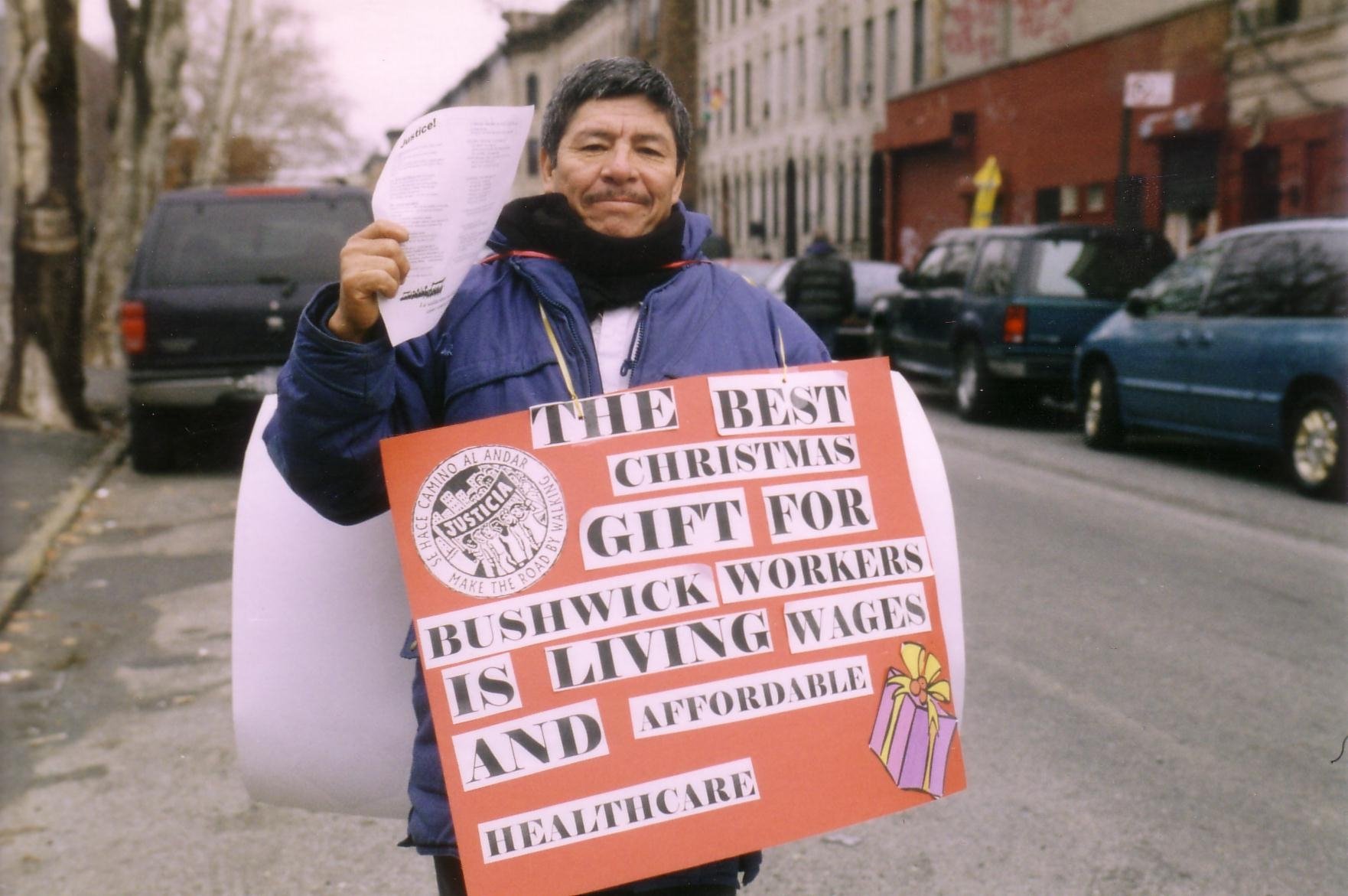
Member of MRBY at a Living Wages action. Bushwick, Brooklyn, c. 1990s. © Make The Road New York Archives.
In 2022, MRNY’s advocacy work helped newly-arrived migrants have access to cash assistance, prepaid phones and services. Just this year, MRNY won New York City legislation to make it easier for low-income and homeless New Yorkers to get permanent housing, and played an instrumental role in urging the Biden administration to extend and redesignate Temporary Protected Status (TPS) for Venezuelans. As a result of this policy, more than 470,000 Venezuelans residing in the U.S.–tens of thousands of whom reside in New York–can now receive work permits and immediately start contributing to the country's economy and local communities.
“We are proud of this monumental milestone and the community we have built over the last 25 years,” Theo Oshiro, Co-Executive Director of Make the Road New York, stated. “With a vision for racial equity and social justice, we have built collective power together with working class people, provided lifesaving services, and won major organizing victories locally and nationally.” For Oshiro, with thousands of members and offices throughout the city, state, and country, the legacy of MRNY continues full steam ahead: “Our members will continue to champion efforts to win workplace justice, truly affordable housing, an end to abusive policing, the decriminalization of sex work, and access to healthcare for all people regardless of immigration status. Our work fighting for dignity and respect continues.”
Make The Road New York Retrospective: A Glimpse into the 1990s and early 2000s

Members of the Latin American Integration Center (LAIC). Queens, c. 1990s. © Make The Road New York Archives.

Members of LAIC’s Adult Education program. Queens, c. 1990s. © Make The Road New York Archives.

Manhattan, c. 1990s. © Make The Road New York Archives.

Youth members of MRBY working on a community mural. Grove Street Park, Bushwick, Brooklyn, c. 1990s, early 2000s. © Make The Road New York Archives.

Drummers and dancers at MRBY. Bushwick, Brooklyn, c. 1990s, early 2000s. © Make The Road New York Archives.

MRBY members at an Immigrants Deserve Equal Access rally. Manhattan, c. 1990s. © Make The Road New York Archives.

Crowd photo at the Freedom Ride, c. 1990s. © Make The Road New York Archives.

Tenants Rights activation. Bushwick, Brooklyn, c. 1990s. © Make The Road New York Archives.